Skip to Sidebar Skip to Content
Entralon Hub | Real Estate Think Tank & Global Community Entralon Hub | Real Estate Think Tank & Global Community
Anonymous

  • Sign in
  • Home
  • The Playbook
  • Market Watch
  • Field Notes
  • Authors & Publishers
  • About Us
  • Browse properties
  • Entralon Academy
  • Entralon Club
Tags
  • Beginner
  • Finance
  • Blueprint
  • Market Pulse
  • Instagram
  • Youtube
  • Whatsapp
  • X
  • TikTok
  • Linkedin
© 2026  Entralon Group

Why Short-Term Interest-Rate Changes Influence Mortgage Choices More Than Fundamentals

  • Yevgeny Mugerman by Yevgeny Mugerman
    Yevgeny Mugerman Yevgeny Mugerman
    Yevgeny Mugerman is an Associate Professor at Bar-Ilan University and Associate Editor at The Journal of FinTech, specialising in financial markets and behavioural finance.
      Moran Ofir
      Moran Ofir Moran Ofir
      Prof. Moran Ofir is a Professor of Law & Finance at the University of Haifa, specialising in fintech, behavioural finance, and financial decision-making, with extensive academic and regulatory experience.
        Moran Ofir Moran Ofir Zvi Wiener Zvi Wiener
      • •
      • January 03, 2026
      • •
      • 5 min read
      • Share on X
      • Share on Facebook
      • Share on LinkedIn
      • Share on Pinterest
      • Email
      Why Short-Term Interest-Rate Changes Influence Mortgage Choices More Than Fundamentals

      Lenders are trained to track every fluctuation of the interest-rate curve, scanning movements the way pilots scan an instrument panel. Yet the market’s real turbulence often comes from a different source. The greatest instability is generated not by the rate environment itself, but by how borrowers interpret that environment and how quickly those interpretations shift.

      Institutions often expect mortgage demand to follow economic logic: relative pricing, long-term expectations, and repayment capacity. Still, the evidence points to a sharper and more human pattern. Borrowers anchor on whatever rate movement is most recent and respond instinctively. This behavioural swing reshapes FRM and ARM demand in ways that portfolio planners cannot predict using fundamentals alone.

      A more reliable path emerges when lenders start mapping the “data rhythm” behind borrower reactions, not just the rate cycle. Understanding behaviour becomes a strategic advantage, one that stabilises product allocation before volatility spills into balance sheets.

      Join Entralon Hub

      Receive weekly research-backed articles that turn complex property data into clear, actionable intelligence.

      Email sent! Check your inbox to complete your signup.

      No spam. Unsubscribe anytime.

      Understanding the Landscape

      Borrower decision-making rarely resembles the structured, multi-variable evaluation that institutions expect. Instead, people lean on intuitive shortcuts — especially availability and representativeness heuristics. These heuristics make recent rate changes feel more important than underlying drivers such as income trends, inflation expectations, or duration structures.

      Research shows that even small shifts in short-term rates can redirect borrowers toward or away from fixed-rate mortgages. Fundamentals may remain steady; pricing variables may not justify a shift; yet demand changes anyway.

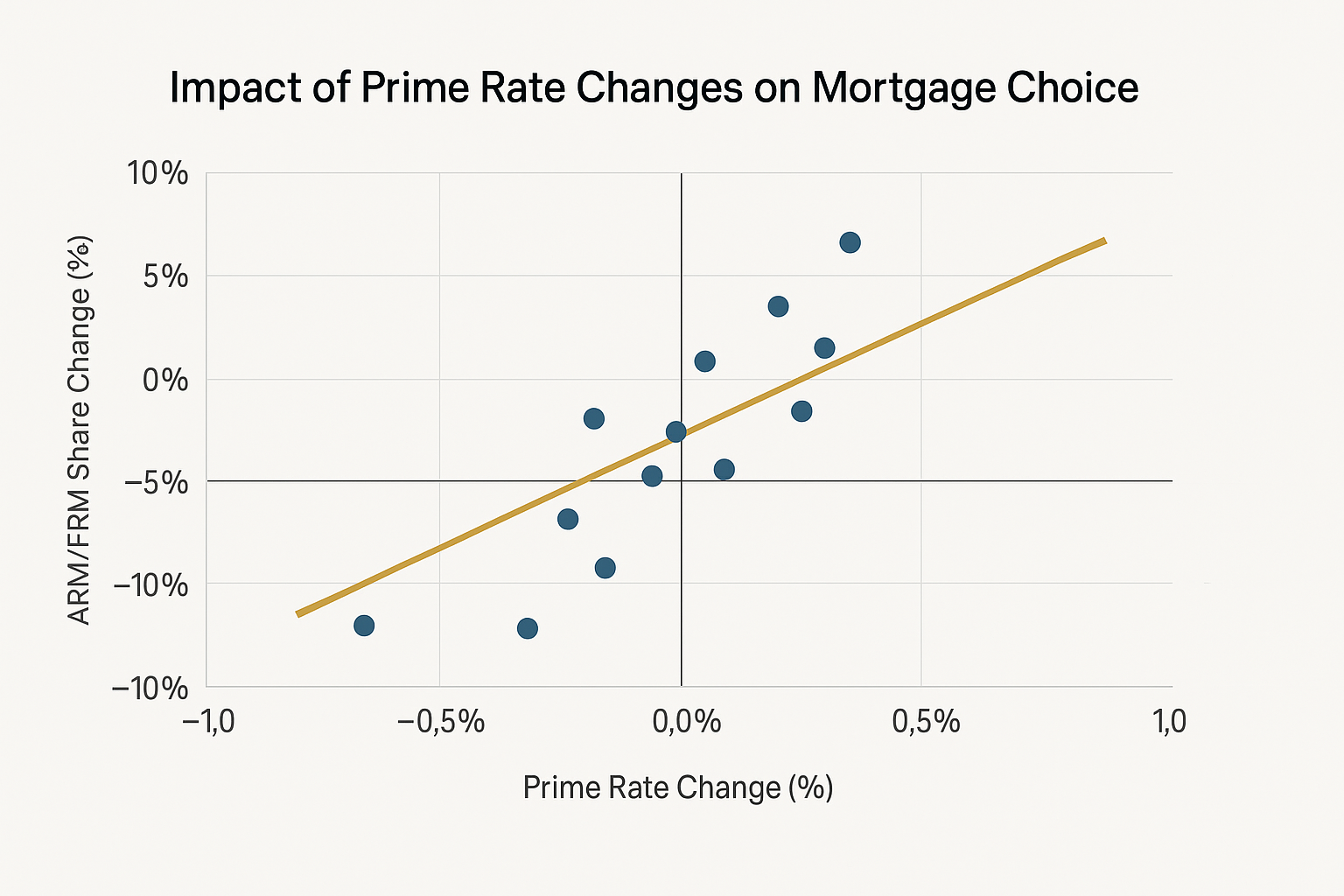
      Short-term prime rate changes show a strong relationship with shifts between fixed- and adjustable-rate mortgages, even when fundamentals remain unchanged.
      Short-term prime rate changes show a strong relationship with shifts between fixed- and adjustable-rate mortgages, even when fundamentals remain unchanged.

      The underlying pattern stays consistent across environments, particularly during periods when rates feel high or unusually salient.

      Such behaviour complicates institutional planning. Forecasting drifts out of alignment. Duration concentration grows when many borrowers lock into the same product at once. Pricing assumptions clash with sentiment-based decisions. And capital planning becomes reactive rather than anticipatory.

      In today’s environment, where information flows faster and market narratives shift by the hour, behavioural sensitivity has only intensified. The risk is less about interest rates themselves, and more about human perception amplified by a faster information ecosystem.

      Silkstream - London

      Strong Fundamentals, Surprisingly Low Entry Point - Perfect for internationals and investors

      The Hidden Dynamic Behind Borrower Choices

      Many institutional models quietly assume rational decision-making. They expect borrowers to compare long-term cost, assess risk exposure, and weigh macroeconomic direction. Yet the observed behaviour tells a different story: borrowers respond primarily to the last rate movement they noticed.

      When short-term rates fall, fixed-rate demand rises, even if nothing else in the system supports that preference. When rates rise, adjustable-rate choices climb again. These shifts appear quickly and often contradict the broader environment. High-rate periods make movements feel even sharper, intensifying the behavioural effect.

      Recognising this pattern changes the forecasting approach. Mortgage allocation is not simply a function of rate economics; it is shaped by behavioural conditions that sit outside traditional models. Borrowers are reacting to the feel of the rate environment, not the long-term structure of it.

      Institutions that decode these heuristics gain a structural advantage. Instead of reacting to borrower behaviour after it appears in the data, they can anticipate shifts earlier, model product demand more accurately, and design offerings that meet behavioural reality rather than theoretical assumptions.

      Silkstream - London

      Strong Fundamentals, Surprisingly Low Entry Point - Perfect for internationals and investors

      From Insight to Action

      Step 1: Integrate behavioural variables into demand forecasting

      Add inputs such as rate-change frequency, direction, and public visibility. These variables show earlier and stronger correlations with borrower decisions than many traditional fundamentals. Integrating them into forecasting improves accuracy during volatile environments and reduces unexpected demand spikes.

      Free membership in the global think tank shaping the future of real estate.

      Step 2: Reassess pricing models for behavioural elasticity

      This post is for subscribers only

      Become a member now and have access to all posts, enjoy exclusive content, and stay updated with constant updates.

      Become a member

      Already have an account? Sign in

      Yevgeny Mugerman Yevgeny Mugerman
      Yevgeny Mugerman is an Associate Professor at Bar-Ilan University and Associate Editor at The Journal of FinTech, specialising in financial markets and behavioural finance.
        Yevgeny Mugerman Yevgeny Mugerman
        Yevgeny Mugerman is an Associate Professor at Bar-Ilan University and Associate Editor at The Journal of FinTech, specialising in financial markets and behavioural finance.
          On this page
          Unlock full content
          Please check your inbox and click the confirmation link.

          Read Next

          Access Is Not Enough: Tokenisation in a Maturing Real Estate Market 4 min read

          Access Is Not Enough: Tokenisation in a Maturing Real Estate Market

          Michal Kubicki Michal Kubicki
          Michal Kubicki Michal Kubicki
          Chair at Real Estate Commitee at Polish Chamber of Commerce/Council Member at Polish-Spanish Chamber of Commerce/CEO Omega Asset management/CMP Center Management Polska
            Apr 19, 2026
            How Architectural Practices Must Re-Tool for Long-Term Performance 2 min read

            How Architectural Practices Must Re-Tool for Long-Term Performance

            Iwein Meyskens Iwein Meyskens
            Iwein Meyskens Iwein Meyskens
            Civil engineer-architect, co-founder and managing director of Archipelago. Specialised in research-driven architecture for living, care, work and learning, with a focus on user experience, sustainability and circular building economics.
              Apr 18, 2026
              From Regional Market to Global Scale: How Poland’s Top-20 Economy Status Repositions Real Estate Capital 5 min read

              From Regional Market to Global Scale: How Poland’s Top-20 Economy Status Repositions Real Estate Capital

              Michal Kubicki Michal Kubicki
              Michal Kubicki Michal Kubicki
              Chair at Real Estate Commitee at Polish Chamber of Commerce/Council Member at Polish-Spanish Chamber of Commerce/CEO Omega Asset management/CMP Center Management Polska
                Apr 17, 2026
                Architecture as Capital Signal: How Design Is Reshaping Foreign Investment in Albania 6 min read

                Architecture as Capital Signal: How Design Is Reshaping Foreign Investment in Albania

                Adelajda Roka Adelajda Roka
                Adelajda Roka Adelajda Roka
                Adelajda Roka is an experienced legal consultant and executive leader with a strong background in national and international project management. Currently serving as the General Director of the Agency of Territorial Development.
                  Apr 16, 2026
                  How Next-Generation Data Rooms Are Reshaping Real Estate Decision-Making 4 min read

                  How Next-Generation Data Rooms Are Reshaping Real Estate Decision-Making

                  Holger Weber Holger Weber
                  Holger Weber Holger Weber
                  Study Maths, Physics, Information Science. Founder of x.project AG, which is an engineering and software office in Frankfurt. Highly interested in technical aspects of real estate including sustainability and resilience.
                    Apr 15, 2026
                    The new investor reality: pricing environmental risk before market volatility 4 min read

                    The new investor reality: pricing environmental risk before market volatility

                    Amer Khansaheb Amer Khansaheb
                    Amer Khansaheb Amer Khansaheb
                    CEO & Board Member of Union Properties
                      Apr 14, 2026
                      Why Germany’s Residential Imbalance Still Attracts Capital 5 min read

                      Why Germany’s Residential Imbalance Still Attracts Capital

                      Markus Lambrecht Markus Lambrecht
                      Markus Lambrecht Markus Lambrecht
                        Mar 16, 2026
                        ESG and the Shift Toward Disciplined Development: Lessons from Poland’s Commercial Real Estate Market 4 min read

                        ESG and the Shift Toward Disciplined Development: Lessons from Poland’s Commercial Real Estate Market

                        Wirginia Leszczyńska Wirginia Leszczyńska
                        Wirginia Leszczyńska Wirginia Leszczyńska
                        Wirginia Leszczyńska is COO & CSO at DL Invest Group, driving 17+ years of strategic growth, digital transformation, and ESG-led investment to maximize portfolio value in Poland’s property market.

                          Mar 13, 2026
                          The Insider Advantage: How to Spot Hidden Market Signals Before You Buy Your First Home 6 min read

                          The Insider Advantage: How to Spot Hidden Market Signals Before You Buy Your First Home

                          Pablo Kurlat Pablo Kurlat
                          Pablo Kurlat Pablo Kurlat
                          Professor of Economics, University of Southern California
                            Johannes Stroebel
                            Johannes Stroebel Johannes Stroebel
                            David S. Loeb Professor of FinanceDirector, Climate Finance InitiativeNBER Research AssociateCEPR Research AffiliateCESifo Research Fellow

                              Johannes Stroebel Johannes Stroebel
                              Mar 13, 2026
                              Winning the Long Game: A Roadmap for the Modern Real Estate Professional 6 min read

                              Winning the Long Game: A Roadmap for the Modern Real Estate Professional

                              Johannes Brinkmann Johannes Brinkmann
                              Johannes Brinkmann Johannes Brinkmann
                              Bi Norwegian Business School, Department of Strategy and Logistics, Faculty Member
                                Mar 12, 2026

                                Subscribe to Newsletter

                                Join me on this exciting journey as we explore the boundless world of web design together.

                                Please check your inbox and click the confirmation link.
                                Entralon Hub | Real Estate Think Tank & Global Community Entralon Hub | Real Estate Think Tank & Global Community
                                • Home
                                • The Playbook
                                • Market Watch
                                • Field Notes
                                • Authors & Publishers
                                • About Us
                                • Browse properties
                                • Entralon Academy
                                • Entralon Club
                                Tags
                                • Beginner
                                • Finance
                                • Blueprint
                                • Market Pulse
                                • Instagram
                                • Youtube
                                • Whatsapp
                                • X
                                • TikTok
                                • Linkedin
                                © 2026  Entralon Group