Adelajda Roka is an experienced legal consultant and executive leader with a strong background in national and international project management. Currently serving as the General Director of the Agency of Territorial Development.
This article is part of Entralon Hub’s Leadership View series, where senior real estate leaders examine the structural forces shaping the next phase of residential investment and market behaviour.
In this feature, Adelajda Roka, General Director at the Territorial Development Agency in Albania, explores how international-grade architecture is emerging as a strategic driver of foreign investment in Albania reshaping perception, confidence, and long-term value creation across the country’s real estate market.
Albania is entering a pivotal phase in its development. According to UNCTAD and the U.S. State Department (2025), Albania’s FDI inflows averaged $1.33 billion annually between 2018–2023, reaching a record $1.68 billion in 2023.
Construction and real estate-related activities account for a significant share of recent capital formation, reflecting growing investor confidence in urban and tourism-led development.
Pro-investor policies, strategic geographic positioning, and an ambitious architectural transformation are converging in ways that are beginning to reposition the country within the broader Mediterranean and European investment landscape.
Not only across cities such as Tirana, Vlora, and Durrës, but now throughout Albania, landmark projects and urban regeneration initiatives are reshaping skylines and redefining how Albania is perceived from the outside.
Architecture, once a symbolic layer of development, is increasingly functioning as a strategic signal communicating credibility, ambition, and market readiness to foreign capital.This signalling effect is particularly relevant in emerging markets, where visible urban transformation often precedes institutional capital entry.
Insights from Those Who Shape the Market
Subscribe to get first access to exclusive interviews and perspectives from top industry voices.
No spam. Unsubscribe anytime.
In capital allocation terms, architecture operates as a visible proxy for governance capacity, regulatory predictability, and long-term urban planning coherence, which are actually factors that materially influence foreign investors’ risk-adjusted return expectations.
From Aesthetics to Investment Signal
In emerging and transitioning markets, foreign investors often rely on visible, legible indicators of quality and long-term intent. In Albania, high-profile architecture has begun to play precisely this role. Construction and real estate have been among the principal channels of capital absorption, reflecting the growing role of urban development in national economic expansion.
On the other hand, the involvement of internationally recognised architectural studios in mixed-use towers, cultural institutions, hospitality assets, and public-space masterplans sends a clear message: projects are being conceived and executed to international standards.
This is not merely about iconic form. It is about signalling that developments are aligned with global expectations around planning sophistication, functional integration, and long-term urban relevance.
As a result, architecture is increasingly intertwined with investor confidence, particularly for capital that is sensitive to perception, risk framing, and place credibility. Rather than operating as symbolic landmarks, these projects increasingly form part of a broader urban capital framework in which design quality, regulatory alignment, and investment policy converge to support long-term value creation.
Beyond individual projects, architecture is shaping Albania’s broader urban narrative. High-quality design has become a tool for place-making and city branding, helping cities articulate a clearer identity on the regional and international stage.
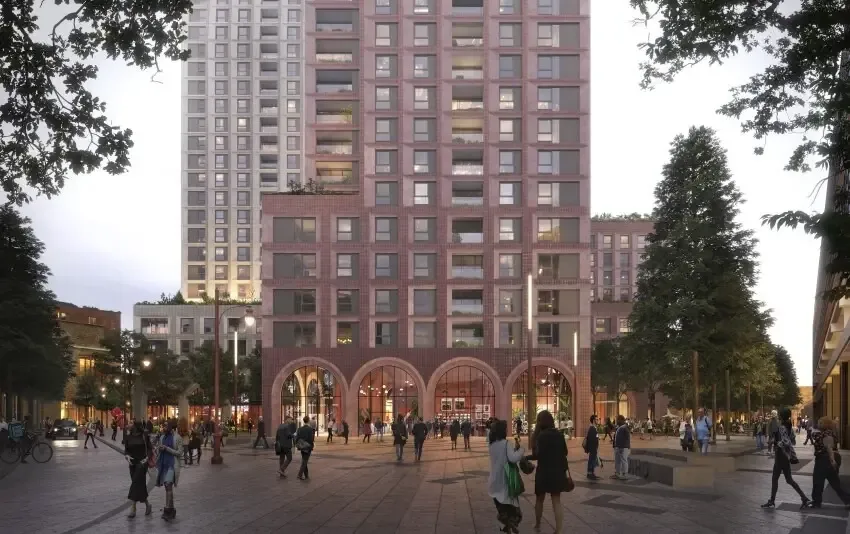
In Tirana, the clustering of internationally designed mixed-use towers in the central business district, including projects by studios such as MVRDV, OMA, and Stefano Boeri Architetti, has coincided with a marked increase in construction intensity and foreign capital allocation to urban real estate.
This concentration of design-led development has done more than alter the skyline. It has created identifiable investment districts with sufficient scale, density, and functional integration to attract institutional and cross-border capital.
For international investors, such clustering reduces fragmentation risk and enhances asset liquidity, two critical factors in emerging European markets.
This shift matters because foreign investment rarely responds to isolated assets alone. It responds to cities and destinations that appear coherent, forward-looking, and investable as systems.
Free membership in the global think tank shaping the future of real estate.
Urban regeneration initiatives and architecturally ambitious developments contribute to this coherence, reinforcing the idea that Albania is not only open to capital, but capable of sustaining it.
Adelajda Roka is an experienced legal consultant and executive leader with a strong background in national and international project management. Currently serving as the General Director of the Agency of Territorial Development.
Chair at Real Estate Commitee at Polish Chamber of Commerce/Council Member at Polish-Spanish Chamber of Commerce/CEO Omega Asset management/CMP Center Management Polska
Civil engineer-architect, co-founder and managing director of Archipelago. Specialised in research-driven architecture for living, care, work and learning, with a focus on user experience, sustainability and circular building economics.
Chair at Real Estate Commitee at Polish Chamber of Commerce/Council Member at Polish-Spanish Chamber of Commerce/CEO Omega Asset management/CMP Center Management Polska
Study Maths, Physics, Information Science. Founder of x.project AG, which is an engineering and software office in Frankfurt. Highly interested in technical aspects of real estate including sustainability and resilience.
Wirginia Leszczyńska is COO & CSO at DL Invest Group, driving 17+ years of strategic growth, digital transformation, and ESG-led investment to maximize portfolio value in Poland’s property market.
Logan is an MIT graduate with 5 years of experience in RE finance and development. At Boyer and PEG, he managed major industrial projects and secured institutional capital. He holds a BS from BYU.
Subscribe to Newsletter
Join me on this exciting journey as we explore the boundless world of web design together.