Skip to Sidebar Skip to Content
Entralon Hub | Real Estate Think Tank & Global Community Entralon Hub | Real Estate Think Tank & Global Community
Anonymous

  • Sign in
  • Home
  • The Playbook
  • Market Watch
  • Field Notes
  • Authors & Publishers
  • About Us
  • Browse properties
  • Entralon Academy
  • Entralon Club
Tags
  • Beginner
  • Finance
  • Blueprint
  • Market Pulse
  • Instagram
  • Youtube
  • Whatsapp
  • X
  • TikTok
  • Linkedin
© 2026  Entralon Group

Planning Flexibility Is Killing Urban Accountability

  • Dr Enora Robin by Dr Enora Robin
    Dr Enora Robin Dr Enora Robin
    Urban researcher exploring how finance, justice, and climate action shape cities across Accra, London, and Marseille.
    • •
    • October 12, 2025
    • •
    • 5 min read
    • Share on X
    • Share on Facebook
    • Share on LinkedIn
    • Share on Pinterest
    • Email
    Planning Flexibility Is Killing Urban Accountability
    • Blueprint

    Flexibility was meant to make urban development smarter. Instead, it’s quietly eroding public trust. The very tools designed to help real estate developers adapt to changing markets (outline applications, viability assessments, and phased master plans) now serve as instruments to rewrite commitments, sidestep scrutiny, and recast entire neighbourhoods in the image of financial convenience.

    Developers once saw flexibility as innovation. Today, it risks becoming their biggest credibility problem. Large-scale regeneration projects showcase this tension clearly: behind every adaptive clause lies a quiet question of accountability. The challenge is no longer about building cities that move fast, it’s about keeping integrity from getting lost in motion.

    Understanding the Landscape

    Urban development has entered a paradoxical phase. The more complex cities become, the more planning systems attempt to simplify decisions through flexible instruments. These were introduced to accommodate uncertainty, particularly in large regeneration projects where timelines stretch across economic cycles. Yet, as planning laws evolved to allow adaptability, developers increasingly defined what that flexibility meant.

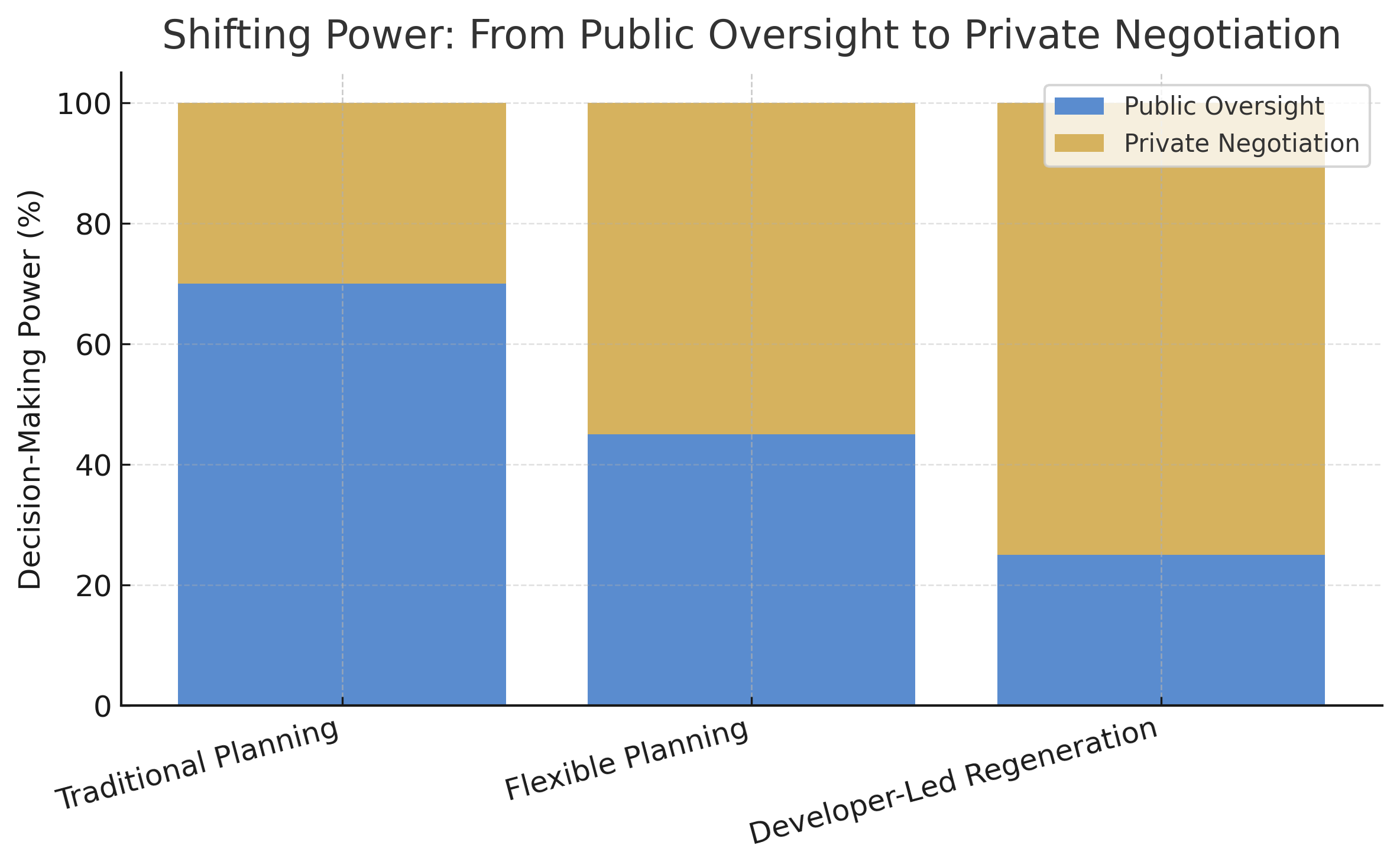
    Flexible planning tools increase developer discretion while reducing the scope of direct public oversight in large regeneration projects.

    Get the Full Analytical Summary (Free Download)

    Access verified data, key insights, and next-quarter trends in one concise PDF, curated by Entralon Hub analysts.

    Email sent! Check your inbox to complete your signup.

    No spam. Unsubscribe anytime.

    The result is a growing disconnect between financial logic and public purpose. Developers, empowered by their control of consultants and risk models, now set the boundaries of “urban expertise.” Viability assessments focus on return and liquidity rather than livability or inclusion. Outline applications enable plans to change post-approval, often justified by shifting market conditions. Over time, these mechanisms transfer authority from public to private domains, transforming planning from a process of negotiation into one of justification.

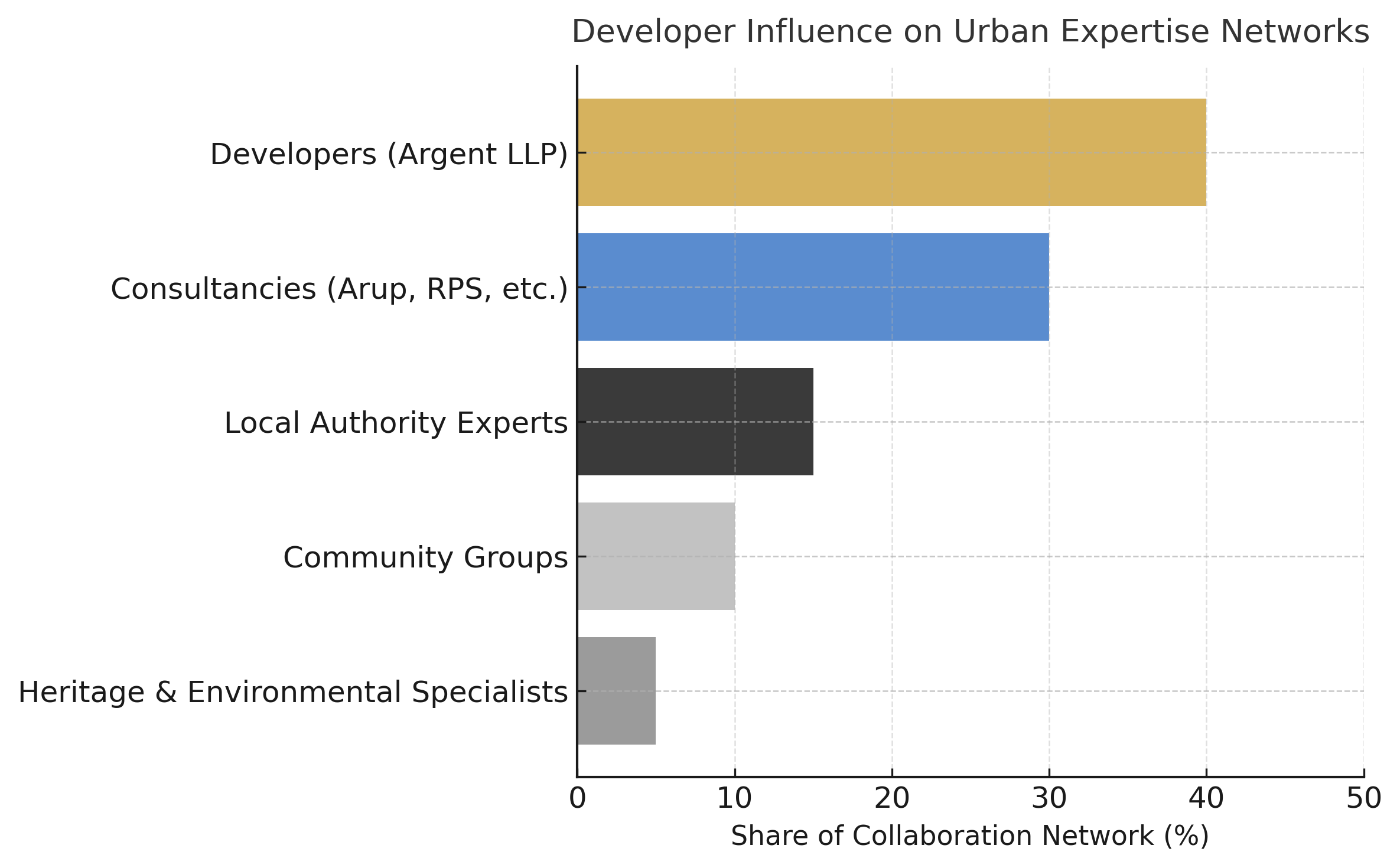
    Developers command the largest share of expert collaborations in major urban projects, shaping how planning knowledge and evidence are produced.

    For developers, this shift has a measurable cost. Projects optimized for financial metrics often encounter social resistance, lengthy renegotiations, and reputational strain. Each revision, even when legally sound, erodes confidence among partners, regulators, and the communities they seek to attract. In the long run, that lack of trust becomes a market risk of its own.

    The Hidden Dynamic Behind the Problem

    The underlying problem is not malice or misconduct; it is structure. Flexibility has been engineered as a privilege, not a shared principle. When every rule can bend, accountability dissolves. The systems meant to enable responsiveness end up replacing democratic checks with private discretion.

    Most planners and developers misunderstand where the real distortion begins. It is not in the boardroom debate over profit margins, but in the tools themselves, the viability models, technical reports, and planning briefs that present private objectives as public reason. These documents, often thousands of pages long, are both shield and sword: too complex for communities to contest and too technical for elected officials to question. What appears as evidence is, in practice, performance.

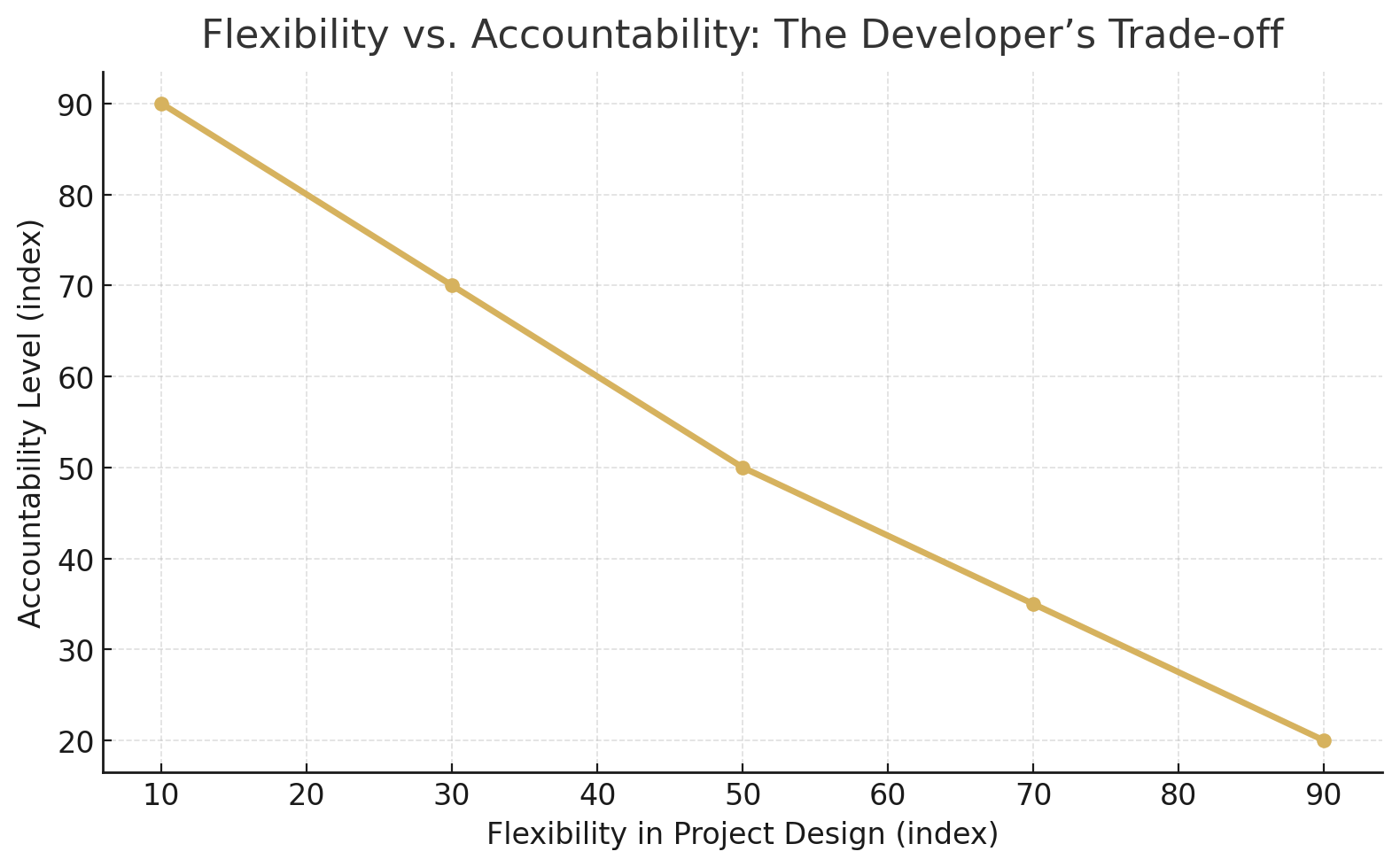
    As flexibility in project design increases, accountability indicators decline, revealing the core tension of modern urban governance.

    Yet the insight that reframes this problem is simple: adaptability without governance isn’t flexibility, it’s drift. True flexibility depends on fixed anchors, transparent principles, measurable commitments, and a shared definition of value that extends beyond immediate financial yield. Developers who recognize this distinction can turn flexibility into an asset again.

    If you want to stay ahead of market shifts like this;
    Join Entralon Hub for free weekly insights.

    Free membership

    From Insight to Action

    To rebuild accountability without losing adaptability, developers must design flexibility as a managed process, not an open permission. The following roadmap translates that principle into five clear steps.

    Step 1: Establish Accountability Checkpoints

    Every major project stage, from concept to completion, should include formal reviews assessing whether evolving plans still meet the original social, environmental, and spatial objectives. These checkpoints create institutional memory and prevent “mission drift.” They also give developers credible evidence that adaptability has not compromised public value, strengthening their position in regulatory negotiations.

    Step 2: Disclose Risk Transparently

    This post is for subscribers only

    Become a member now and have access to all posts, enjoy exclusive content, and stay updated with constant updates.

    Become a member

    Already have an account? Sign in

    Dr Enora Robin Dr Enora Robin
    Urban researcher exploring how finance, justice, and climate action shape cities across Accra, London, and Marseille.
      Dr Enora Robin Dr Enora Robin
      Urban researcher exploring how finance, justice, and climate action shape cities across Accra, London, and Marseille.
        On this page
        Unlock full content
        Please check your inbox and click the confirmation link.

        Read Next

        Why Tender Drawings Are No Longer the Final Product 2 min read

        Why Tender Drawings Are No Longer the Final Product

        Iwein Meyskens Iwein Meyskens
        Iwein Meyskens Iwein Meyskens
        Civil engineer-architect, co-founder and managing director of Archipelago. Specialised in research-driven architecture for living, care, work and learning, with a focus on user experience, sustainability and circular building economics.
          Mar 9, 2026
          How Rising Interest Rates Reshape the Housing Market 6 min read

          How Rising Interest Rates Reshape the Housing Market

          Karsten Gerdrup Karsten Gerdrup
          Karsten Gerdrup Karsten Gerdrup
          Karsten R. Gerdrup is Director of Analysis at Norges Bank, specializing in monetary policy, macro-financial modeling, and forecasting. An economist with extensive policy experience, he contributes to financial stability and fiscal policy analysis.
            Kjersti Næss Torstensen
            Kjersti Næss Torstensen Kjersti Næss Torstensen
              Kjersti Næss Torstensen Kjersti Næss Torstensen
              Mar 9, 2026
              The Green Performance Gap: Why Efficiency Without Intelligence is a Sunk Cost 6 min read

              The Green Performance Gap: Why Efficiency Without Intelligence is a Sunk Cost

              Farheen Naz Farheen Naz
              Farheen Naz Farheen Naz
                Professor Anil Kumar
                Professor Anil Kumar Professor Anil Kumar
                  Professor Anil Kumar Professor Anil Kumar
                  Mar 4, 2026
                  Abu Dhabi and the Institutional Foundations of Long-Term Real Estate Confidence 4 min read

                  Abu Dhabi and the Institutional Foundations of Long-Term Real Estate Confidence

                  Svetlana Fedosova Svetlana Fedosova
                  Svetlana Fedosova Svetlana Fedosova
                  Svetlana Fedosova is the Founder of Entralon Club and a real estate strategist focused on decision architecture, governance, and institutional trust across global property markets.
                    Mar 3, 2026
                    The Strategy That Helped Developers Survive Market Volatility (Lessons from Dubai’s property development sector) 6 min read

                    The Strategy That Helped Developers Survive Market Volatility (Lessons from Dubai’s property development sector)

                    Virginia Bodolica Virginia Bodolica
                    Virginia Bodolica Virginia Bodolica
                    Business school professor specialising in corporate governance, strategy and leadership. Researcher and consultant working with global organisations, with publications in leading journals.
                      Martin Spraggon
                      Martin Spraggon Martin Spraggon
                      Professor Martin Spraggon is a global expert in strategy, innovation and leadership, with 25+ years of international experience. He advises executives and has authored 100+ publications and two books.
                        Martin Spraggon Martin Spraggon
                        Mar 3, 2026
                        Poland’s Real Estate Outlook in 2026: Stability Is the Undervalued Asset 5 min read

                        Poland’s Real Estate Outlook in 2026: Stability Is the Undervalued Asset

                        Michal Kubicki Michal Kubicki
                        Michal Kubicki Michal Kubicki
                        Chair at Real Estate Commitee at Polish Chamber of Commerce/Council Member at Polish-Spanish Chamber of Commerce/CEO Omega Asset management/CMP Center Management Polska
                          Mar 2, 2026
                          De-Risking Large-Scale Development: Navigating Regulatory and Community Risks in Global Markets 7 min read

                          De-Risking Large-Scale Development: Navigating Regulatory and Community Risks in Global Markets

                          Frances Brill Frances Brill
                          Frances Brill Frances Brill
                          Dalberg strategy consultant (Deputy, Cities & Urban Development) and UCL Bartlett lecturer in planning & housing. PhD geographer studying London real estate investment governance.
                            Dr Enora Robin
                            Dr Enora Robin Dr Enora Robin
                            Urban researcher exploring how finance, justice, and climate action shape cities across Accra, London, and Marseille.
                              Dr Enora Robin Dr Enora Robin
                              Mar 2, 2026
                              Why Complex Shopping Centres Have Become an Operational Asset Class 4 min read

                              Why Complex Shopping Centres Have Become an Operational Asset Class

                              André Wittstock André Wittstock
                              André Wittstock André Wittstock
                                Mar 1, 2026
                                Move or Wait? London’s February 2026 Property Signal 7 min read

                                Move or Wait? London’s February 2026 Property Signal

                                E-lon E-lon
                                E-lon E-lon
                                E-Lon is Entralon’s AI analyst — scanning markets, predicting trends, and powering smart insights to help investors and readers stay ahead of the curve.
                                  Feb 27, 2026
                                  Why Port and Gateway Cities Are Emerging as Long-Term Residential-Led Investment Destinations 6 min read

                                  Why Port and Gateway Cities Are Emerging as Long-Term Residential-Led Investment Destinations

                                  Angela Michalopoulou Angela Michalopoulou
                                  Angela Michalopoulou Angela Michalopoulou
                                  Senior Executive with 25 years in investment and real estate development, focused on the Greek market. PhD in Chemical Engineering and MBA. Currently at DKG Development, driving asset growth and strategic expansion.
                                    Feb 26, 2026

                                    Subscribe to Newsletter

                                    Join me on this exciting journey as we explore the boundless world of web design together.

                                    Please check your inbox and click the confirmation link.
                                    Entralon Hub | Real Estate Think Tank & Global Community Entralon Hub | Real Estate Think Tank & Global Community
                                    • Home
                                    • The Playbook
                                    • Market Watch
                                    • Field Notes
                                    • Authors & Publishers
                                    • About Us
                                    • Browse properties
                                    • Entralon Academy
                                    • Entralon Club
                                    Tags
                                    • Beginner
                                    • Finance
                                    • Blueprint
                                    • Market Pulse
                                    • Instagram
                                    • Youtube
                                    • Whatsapp
                                    • X
                                    • TikTok
                                    • Linkedin
                                    © 2026  Entralon Group