Skip to Sidebar Skip to Content
Entralon Hub | Real Estate Think Tank & Global Community Entralon Hub | Real Estate Think Tank & Global Community
Anonymous

  • Sign in
  • Home
  • The Playbook
  • Market Watch
  • Field Notes
  • Authors & Publishers
  • About Us
  • Browse properties
  • Entralon Academy
  • Entralon Club
Tags
  • Beginner
  • Finance
  • Blueprint
  • Market Pulse
  • Instagram
  • Youtube
  • Whatsapp
  • X
  • TikTok
  • Linkedin
© 2026  Entralon Group

Brexit was meant to cool London’s property market; instead, it made first homes even harder to buy.

  • Maria Stavridou by Maria Stavridou
    Maria Stavridou Maria Stavridou
    Hi, I am Maria Stavridou. My fields of interests are Real Estate Economics and Real Estate Investment.
      Dr. Thomas Dimopoulos
      Dr. Thomas Dimopoulos Dr. Thomas Dimopoulos
      I’m a real estate expert with 20+ years in valuation, taxation, and investment. Founder & CEO of AXIA Chartered Surveyors and Assistant Professor at Neapolis University, uniting industry insight with academic innovation.
        Dr. Thomas Dimopoulos Dr. Thomas Dimopoulos Dr. Martha Katafygiotou Dr. Martha Katafygiotou
      • •
      • October 10, 2025
      • •
      • 6 min read
      • Share on X
      • Share on Facebook
      • Share on LinkedIn
      • Share on Pinterest
      • Email
      Brexit was meant to cool London’s property market; instead, it made first homes even harder to buy.
      • Blueprint

      For years, policymakers and analysts expected that economic uncertainty and regulatory change would slow the city’s relentless price growth. Yet as the dust settled, the opposite occurred: prices remained high, affordability eroded further, and first-time buyers found themselves squeezed between rising borrowing costs and limited supply.

      The paradox lies in the structure of the market itself. Political events and monetary shifts often make headlines, but the deeper forces behind affordability move more quietly, through construction bottlenecks, population pressure, and cost inflation. For those trying to enter the London housing market, these unseen mechanics matter far more than campaign promises or policy announcements.

      Understanding the Landscape

      London’s housing market has long been shaped by the tension between demand and supply, and the years around Brexit only amplified that imbalance. Population growth and a persistent shortage of new homes intensified price pressures. Meanwhile, construction costs surged as labour shortages and material inflation tightened supply even further.

      Get the Full Analytical Summary (Free Download)

      Access verified data, key insights, and next-quarter trends in one concise PDF, curated by Entralon Hub analysts.

      Email sent! Check your inbox to complete your signup.

      No spam. Unsubscribe anytime.

      Interest rates, which directly influence mortgage affordability, also played a pivotal role. As base rates rose, borrowing became more expensive, particularly for those reliant on high loan-to-income financing.

      Wage growth failed to keep pace with inflation, leaving first-time buyers with a shrinking window of affordability. The data covering 2014–2022 shows a consistent pattern: even when external shocks hit, prices in key London segments remained buoyant.

      At the ground level, this macroeconomic picture translates into a daily struggle for new entrants. Mortgage-backed buyers, especially younger households, were forced to recalibrate budgets or exit the city altogether, while cash buyers, often less sensitive to interest-rate movements, continued to transact.

      The result was a structurally uneven market: resilient on the surface but increasingly inaccessible to those without substantial capital.

      Still, understanding the data reveals more than disappointment; it points to a structural reality. London’s housing challenge was never just about political uncertainty; it was about an urban system unable to adapt to the demands of its population.

      The Hidden Dynamic Behind the Problem

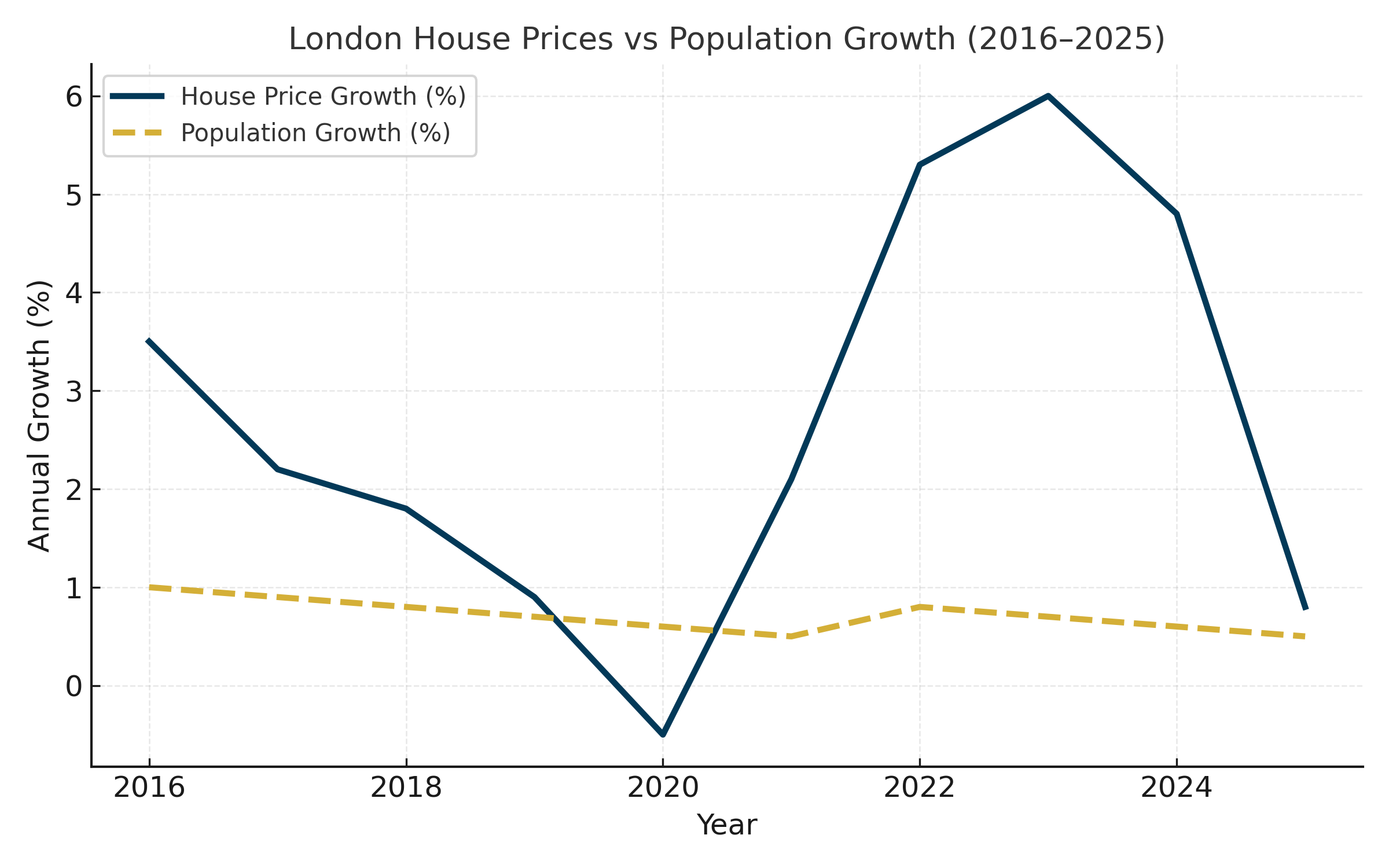
      The most telling discovery in the post-Brexit data is that London’s house prices are far more sensitive to population shifts than to political or financial shocks. The regression models consistently showed that a one percent rise in population corresponded with roughly a four to five percent increase in housing prices. That relationship exposes a fundamental truth: when supply is rigid, even modest demand growth fuels disproportionate price surges.

      Insight Summary: Shows the structural imbalance between demand and limited supply, population growth drives disproportionate price inflation.

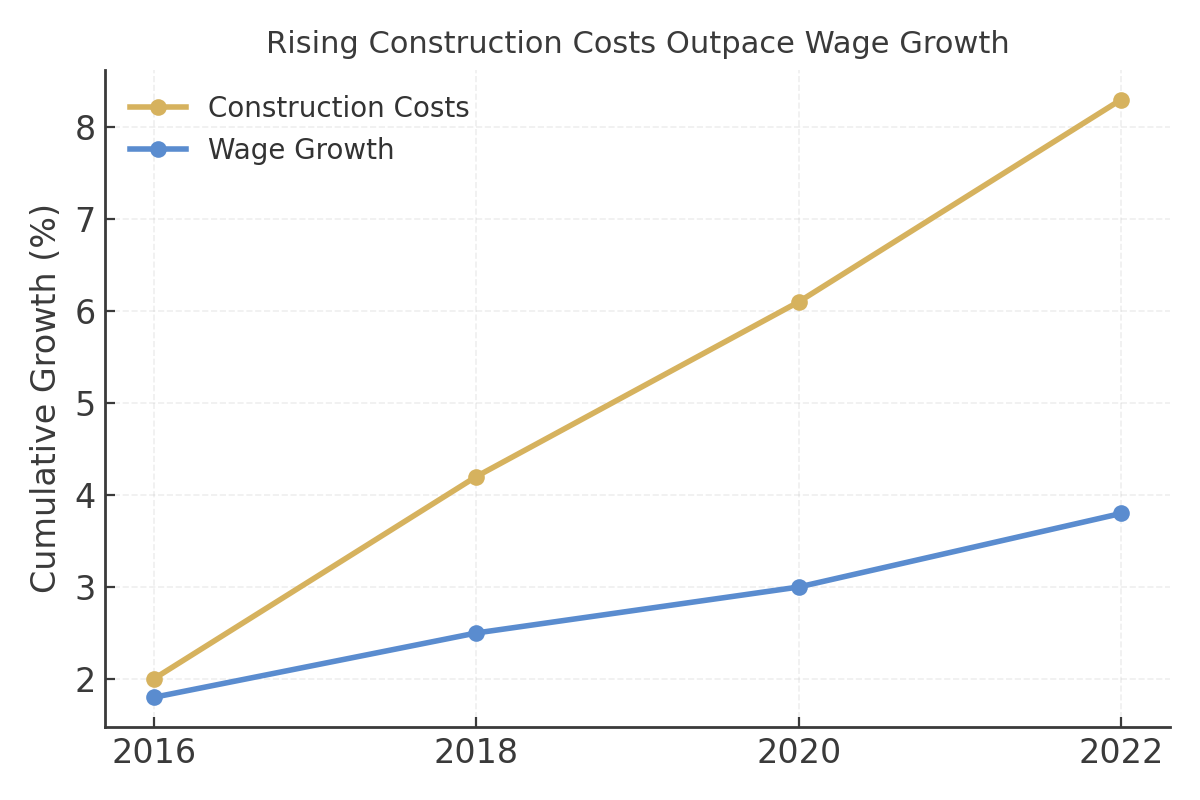
      This finding reframes how we interpret affordability. Rather than viewing Brexit, interest-rate adjustments, or investor sentiment as primary drivers, the real determinant is structural, an ecosystem where new supply chronically lags behind demographic demand. Rising construction costs and limited land availability only amplify the effect.

      Insight Summary: Visualises the inflationary squeeze from build-cost escalation versus stagnant earnings, a core factor in London’s affordability trap.

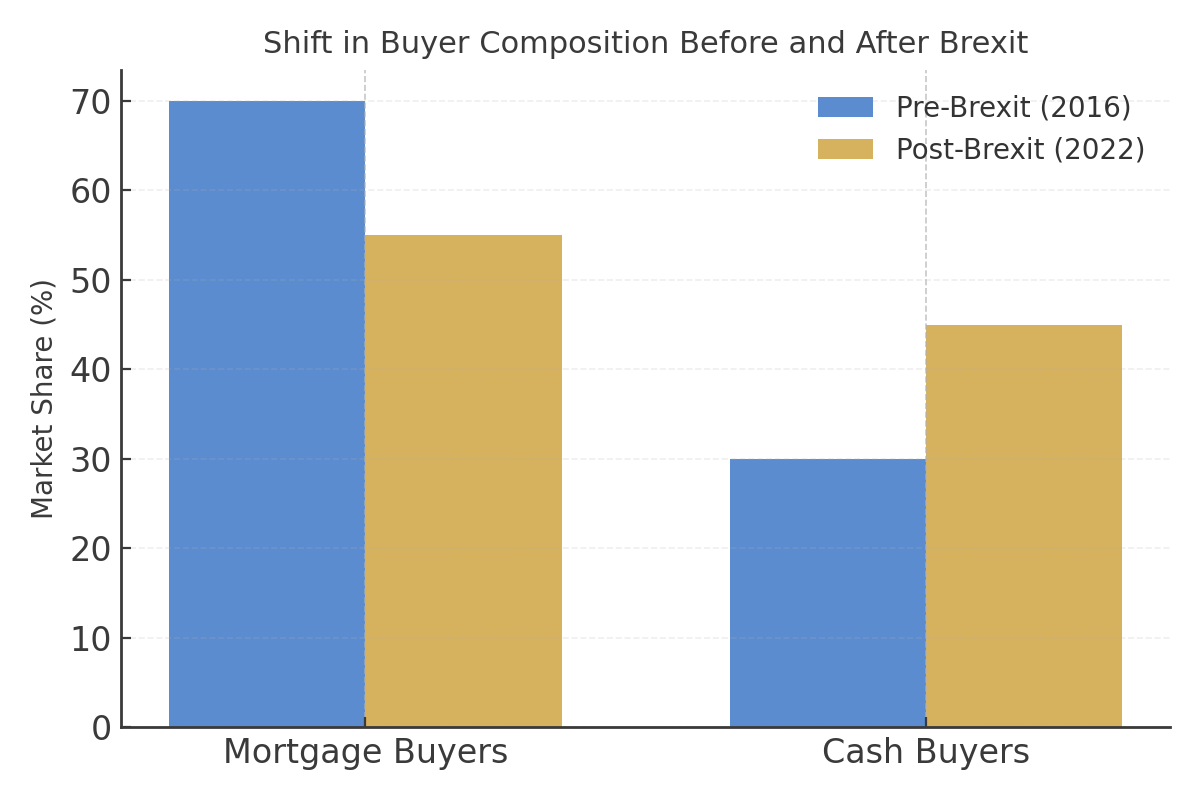
      Another overlooked factor is the stabilising role of cash and foreign investors. Their activity helped prevent a full market correction during periods of volatility. Yet that same resilience also meant that prices never truly adjusted downward, keeping barriers high for first-time buyers dependent on mortgages. Stability, in this case, came at the cost of accessibility.

      Insight Summary: Demonstrates how liquidity-rich investors maintained market stability but widened accessibility gaps for first-time buyers.

      Recognising these patterns helps clarify why standard policy levers, like adjusting base rates, often fail to achieve their intended outcomes. Without addressing the systemic imbalance between population growth and housing delivery, affordability will remain elusive.

      Want to see how these trends evolve each month?
      Visit Entralon Market Watch for verified monthly insights and sector-level data.

      London's property signals - October 2025

      From Insight to Action

      The data points to one conclusion: affordability can only improve when first-time buyers combine strategic timing with informed financial planning. The following steps outline a path for navigating London’s structurally constrained market.

      Step 1: Secure Stability Through Fixed-Rate or Supported Financing

      Volatile interest rates have the greatest impact on first-time buyers. Choosing fixed-rate or government-backed products, such as Help to Buy or Shared Ownership, provides predictability during periods of tightening monetary policy. Stability in repayment terms allows buyers to plan with confidence rather than react to rate fluctuations.

      Step 2: Target Regeneration Zones with Active Supply Growth

      This post is for subscribers only

      Become a member now and have access to all posts, enjoy exclusive content, and stay updated with constant updates.

      Become a member

      Already have an account? Sign in

      Maria Stavridou Maria Stavridou
      Hi, I am Maria Stavridou. My fields of interests are Real Estate Economics and Real Estate Investment.
        Maria Stavridou Maria Stavridou
        Hi, I am Maria Stavridou. My fields of interests are Real Estate Economics and Real Estate Investment.
          On this page
          Unlock full content
          Please check your inbox and click the confirmation link.

          Read Next

          How Next-Generation Data Rooms Are Reshaping Real Estate Decision-Making 4 min read

          How Next-Generation Data Rooms Are Reshaping Real Estate Decision-Making

          Holger Weber Holger Weber
          Holger Weber Holger Weber
          Study Maths, Physics, Information Science. Founder of x.project AG, which is an engineering and software office in Frankfurt. Highly interested in technical aspects of real estate including sustainability and resilience.
            Apr 15, 2026
            The new investor reality: pricing environmental risk before market volatility 4 min read

            The new investor reality: pricing environmental risk before market volatility

            Amer Khansaheb Amer Khansaheb
            Amer Khansaheb Amer Khansaheb
            CEO & Board Member of Union Properties
              Apr 14, 2026
              Why Germany’s Residential Imbalance Still Attracts Capital 5 min read

              Why Germany’s Residential Imbalance Still Attracts Capital

              Markus Lambrecht Markus Lambrecht
              Markus Lambrecht Markus Lambrecht
                Mar 16, 2026
                ESG and the Shift Toward Disciplined Development: Lessons from Poland’s Commercial Real Estate Market 4 min read

                ESG and the Shift Toward Disciplined Development: Lessons from Poland’s Commercial Real Estate Market

                Wirginia Leszczyńska Wirginia Leszczyńska
                Wirginia Leszczyńska Wirginia Leszczyńska
                Wirginia Leszczyńska is COO & CSO at DL Invest Group, driving 17+ years of strategic growth, digital transformation, and ESG-led investment to maximize portfolio value in Poland’s property market.

                  Mar 13, 2026
                  The Insider Advantage: How to Spot Hidden Market Signals Before You Buy Your First Home 6 min read

                  The Insider Advantage: How to Spot Hidden Market Signals Before You Buy Your First Home

                  Pablo Kurlat Pablo Kurlat
                  Pablo Kurlat Pablo Kurlat
                  Professor of Economics, University of Southern California
                    Johannes Stroebel
                    Johannes Stroebel Johannes Stroebel
                    David S. Loeb Professor of FinanceDirector, Climate Finance InitiativeNBER Research AssociateCEPR Research AffiliateCESifo Research Fellow
                      Johannes Stroebel Johannes Stroebel
                      Mar 13, 2026
                      Winning the Long Game: A Roadmap for the Modern Real Estate Professional 6 min read

                      Winning the Long Game: A Roadmap for the Modern Real Estate Professional

                      Johannes Brinkmann Johannes Brinkmann
                      Johannes Brinkmann Johannes Brinkmann
                      Bi Norwegian Business School, Department of Strategy and Logistics, Faculty Member
                        Mar 12, 2026
                        The Digital Foundation: Why Infrastructure is the New Location in Data Center Development 7 min read

                        The Digital Foundation: Why Infrastructure is the New Location in Data Center Development

                        Logan (Robert) Fawcett Logan (Robert) Fawcett
                        Logan (Robert) Fawcett Logan (Robert) Fawcett
                        Logan is an MIT graduate with 5 years of experience in RE finance and development. At Boyer and PEG, he managed major industrial projects and secured institutional capital. He holds a BS from BYU.

                          Mar 11, 2026
                          Move or Wait? London’s March 2026 Property Signal 6 min read

                          Move or Wait? London’s March 2026 Property Signal

                          E-lon E-lon
                          E-lon E-lon
                          E-Lon is Entralon’s AI analyst — scanning markets, predicting trends, and powering smart insights to help investors and readers stay ahead of the curve.
                            Mar 10, 2026
                            Why Tender Drawings Are No Longer the Final Product 2 min read

                            Why Tender Drawings Are No Longer the Final Product

                            Iwein Meyskens Iwein Meyskens
                            Iwein Meyskens Iwein Meyskens
                            Civil engineer-architect, co-founder and managing director of Archipelago. Specialised in research-driven architecture for living, care, work and learning, with a focus on user experience, sustainability and circular building economics.
                              Mar 9, 2026
                              How Rising Interest Rates Reshape the Housing Market 6 min read

                              How Rising Interest Rates Reshape the Housing Market

                              Karsten Gerdrup Karsten Gerdrup
                              Karsten Gerdrup Karsten Gerdrup
                              Karsten R. Gerdrup is Director of Analysis at Norges Bank, specializing in monetary policy, macro-financial modeling, and forecasting. An economist with extensive policy experience, he contributes to financial stability and fiscal policy analysis.
                                Kjersti Næss Torstensen
                                Kjersti Næss Torstensen Kjersti Næss Torstensen
                                  Kjersti Næss Torstensen Kjersti Næss Torstensen
                                  Mar 9, 2026

                                  Subscribe to Newsletter

                                  Join me on this exciting journey as we explore the boundless world of web design together.

                                  Please check your inbox and click the confirmation link.
                                  Entralon Hub | Real Estate Think Tank & Global Community Entralon Hub | Real Estate Think Tank & Global Community
                                  • Home
                                  • The Playbook
                                  • Market Watch
                                  • Field Notes
                                  • Authors & Publishers
                                  • About Us
                                  • Browse properties
                                  • Entralon Academy
                                  • Entralon Club
                                  Tags
                                  • Beginner
                                  • Finance
                                  • Blueprint
                                  • Market Pulse
                                  • Instagram
                                  • Youtube
                                  • Whatsapp
                                  • X
                                  • TikTok
                                  • Linkedin
                                  © 2026  Entralon Group